

BLOG
Critique Guidelines
Unfortunately, many beginning artist let their fear of making errors prevent them from creating anything at all. Don't stop before you start. Get your work out there so people can look at it, give you some advice, and you can get some critiques.
How does one begin a critique? Unfortunately, there are no formulas. You may want to identify the three components of the work (subject, form, and content), evaluate them separately, and then examine how they work together as a whole. Analysis may seem awkward in the beginning, but asking some of the following questions may help.
- What area feels most successful and why?
- What areas feel incomplete or troublesome, and what is the cause?
- How is the subject presented?
- Are there visual or symbolic metaphors that could have helped expand the rendering?
- If the rendering is nonobjective, what suggests the meaning?
- How are the elements used to support or destroy the rendering compositionally?
- Have the principles of organization been observed?
- What is the intention behind the rendering?
- What is being communicated - a feeling, and idea, a personal aesthetic?
- Is it too esoteric?
- Is it to obvious?
- Where does the rendering succeed in integrating these components, and where is it less successful?

Did you enjoy this blog post? If so, then why not:
Leave Comment | Subscribe To This Blog | Email Me
Photoshop CS5: Painting with the Mixer Brush with John Derry
Join John Derry, a pioneer in the field of digital painting, as he shows how to master the natural-media painting features introduced in Photoshop CS5 in
Photoshop CS5: Painting with the Mixer Brush. This course shows how to use the Mixer Brush, the Bristle Tips feature, and a new mechanism for blending colors in Photoshop to add beautiful, painterly effects to photographs, enhance artwork with paint-like strokes and illustrations, and paint entirely new art from scratch. This course also covers customizing brush characteristics and surface textures, applying keyboard shortcuts to paint smoothly and efficiently, and using a Wacom tablet to get the most out of Photoshop CS5’s painting features. Exercise files are included with the course.
Topics include:
- Understanding the axes of motion with a Wacom tablet
- Choosing a brush shape and Bristle Tip
- Adjusting brush angle
- Loading color and control the behavior of the Mixer Brush
- Modifying surface texture
- Simulating the texture of canvas
- Saving tool presets for brushes
- Creating a painting from a photograph
- Painting from scratch with the Mixer Brush
Did you enjoy this blog post? If so, then why not:
Leave Comment | Subscribe To This Blog | Email Me
Transforming a Photo into a Painting with Photoshop with John Derry
Learn to think like a painter and render images from photographs that look like they were created with oils or acrylics, using the latest digital artist's tools. Author and artist John Derry introduces the process of interpreting a photograph into a painted work of art. He begins by explaining his system of visual vocabularies, which describe how to replace the elements of an image with expressive painterly qualities, and also shares the custom brush sets and actions he uses to achieve these results in Photoshop. The course also covers working with filters, layers, effects, and more to add further detail and texture.
Topics include:
- Understanding that resolution is in the brush strokes
- Understanding the subject
- Removing lens distortions
- Using the traditional paint color swatch set
- Making shadow and highlight adjustments
- Simplifying details with filters and Smart Blur
- Cloning layers
- Using custom actions
- Working with canvas texture
- Creating physical surface texture effects
certificates of completion
Did you enjoy this blog post? If so, then why not:
Leave Comment | Subscribe To This Blog | Email Me
How Low Can You Go?
Looking for a good way to raise the rendering bar? If possible, get down low, it's often just that simple. Rendering from a near-to-the-ground perspective is a surprisingly quick and effective method for making your rendering jump out from everyone else's
For example, most children are rendered from a typical grown-up height. For more emotionally engaging rendering, bring your camera to a kneeling height, to catch kids at their eye level.
All this goes for pets, too, as well as flowers and any other short subjects that can be captured low to the ground, For some subjects, you can combine a low perspective with getting close. This can further heighten the importance of small subjects by making them appear large in relation to their surroundings.
Outside on a sunny day include a bold blue sky as the background. For instance, get as low as you can go and then aim up at a subject such as a flower. This will let you include the sky as a colorful backdrop while treating your viewers to something new. I guarantee your viewers will appreciate your fresh take on things.

Did you enjoy this blog post? If so, then why not:
Leave Comment | Subscribe To This Blog | Email Me
What's That?
Step away from your work for at least a day. After coming back, look at what you have created and if you see anything that makes you say, "what's that?", get rid of it. If you say, "what's that?", you can almost guarantee your viewer will say, "what's that?", as well.

Did you enjoy this blog post? If so, then why not:
Leave Comment | Subscribe To This Blog | Email Me
Transforming a Photo into a Painting with Photoshop CS6 with John Derry
Learn to think like a painter and render images that look like they were created with oils or acrylics, using the latest digital artist's tools. Author and artist John Derry introduces the process of interpreting a photograph into a painted work of art. He begins by explaining his system of visual vocabularies, which describe how to replace the visual characteristics of a photograph with that of expressive painting, and also shares the custom brush sets and actions he uses to achieve these results in Adobe Photoshop. The course also covers working with filters, layers, effects, and more to add further detail and texture.
Topics include:
- Setting up a Wacom tablet
- Removing lens distortions
- Correcting distracting image elements
- Making shadow and highlight adjustments
- Simplifying details with filters and Smart Blur
- Modifying color
- Cloning layers
- Using a traditional paint color swatch set
- Using custom actions
- Working with canvas texture
- Creating physical surface texture effects
- Painting with custom brushes

Did you enjoy this blog post? If so, then why not:
Leave Comment | Subscribe To This Blog | Email Me
Removing lens distortion with the Adaptive Wide Angle filter
Did you enjoy this blog post? If so, then why not:
Leave Comment | Subscribe To This Blog | Email Me
Content the 'Why"
The emotional or intellectual message of art is its content
Content is idea-based and means:
- What the artist meant to portray,
- what the artist actually did portray and
- how we react, as individuals, to both the intended and actual messages.
Additionally, content includes ways in which a work was influenced--by religion, or politics, or society in general, or even the artist's use of hallucinogenic substances--at the time it was created. All of these factors, together, make up the content side of art.
Did you enjoy this blog post? If so, then why not:
Leave Comment | Subscribe To This Blog | Email Me
Subject the 'What"
The subject of visual art can be a person, an object, a theme, or an idea.
Subject matter:
Images or topics which comprise the subject matter of a work of art include but are not limited to:
- dreams, emotions, fantasies, figures (allegorical, mythological, nudes, single and group portraits), historical and/or political events, landscapes, religious events, still-life (flowers, interiors, tables of fruit).
Did you enjoy this blog post? If so, then why not:
Leave Comment | Subscribe To This Blog | Email Me
Form the "How"
As a component of art, the word form refers to the total overall arrangement or organization of an artwork
Definition:
(noun) - Form is an element of art. At its most basic, a form is a three-dimensional geometrical figure (i.e.: sphere, cube, cylinder, cone, etc.), as opposed to a shape, which is two-dimensional, or flat.
In a broader sense, form, in art, means the whole of a piece's visible elements and the way those elements are united. In this context, form allows us as viewers to mentally capture the work and understand it.
Finally, form refers to the visible elements of a piece, independent of their meaning. For example, when viewing Leonardo's Mona Lisa, the formal elements therein are: color, dimension, lines, mass, shape, etc., while the feelings of mystery and intrigue the piece evokes are informal products of the viewer's imagination.
Pronunciation: fôrm
Examples:
"Sculpture is not the mere cutting of the form of anything in stone; it is the cutting of the effect of it." - John Ruskin
Did you enjoy this blog post? If so, then why not:
Leave Comment | Subscribe To This Blog | Email Me
Organic Unity = Art?
If an artist is successfully in welding all three of these components (subject, form, and content) in a work, they become inseparable, mutually interactive, and interrelated - as if they were a living organism, When this is achieved, we can say the work has organic unity, containing nothing that is unnecessary or distracting, with relationships that seem inevitable.

Organic Unity
Did you enjoy this blog post? If so, then why not:
Leave Comment | Subscribe To This Blog | Email Me
Leading Lines
Composing a rendering with leading lines is a traditional technique that has long captured the attention of painters, photographers, and architectural illustrators.
Like a tour guide, you'll be leading viewers where you want them to go - by giving direction to the eye. Whether the lines are straight, zigzagging, or softly curving through the composition, viewers will have a sense of the composition, viewers will have a sense of satisfaction after traveling along the line that you, the architectural illustrator, provided. Most often, a leading line starts in the near foreground and then draws your viewer into the heart of your rendering. It's an extremely effective way to direct viewers on a visual journey through your rendering.
Once you start to recognize the potential for leading lines, you'll jump at opportunities to exploit them. They can be see in in landscaping, buildings, shorelines, streets, fences, and more. They can be colorful streaks of moving taillights at night, or they can be the long shadows of a column or tree that extends from the camera to subject.

Did you enjoy this blog post? If so, then why not:
Leave Comment | Subscribe To This Blog | Email Me
Exceptions Can Sometimes Be The Rule
You'll rarely go wrong in choosing a renderings composition that follow the rules. However, for stepping up the creativity at times, don't get locked into the Rule of Thirds as a hard-and-fast policy. At times, it can be restrictive for those 3D scenes that just don't fit onto a Thirds settings. While the perfect spot fir the subject may be somewhere off-center, for example, it might not necessarily be in one of the power points.
In fact, there are times when a dead-center composition is dead-on. This can be a subject with strong symmetry, such as a wheel, in which the hub is in the middle while the spokes spread out in all directions. When rendering close up, work, too, as does symmetry in most of my architectural renderings. Likewise, some renderings don't even have a specific subject; rather, the entire rendering is the subject, such as a pattern or repetition scenes.

Did you enjoy this blog post? If so, then why not:
Leave Comment | Subscribe To This Blog | Email Me
I've completed the Twitter for Business course on lynda.com

Join author Anne-Marie Concepción as she shows you how to leverage the power of tweeting for business promotion and customer engagement. This course reviews the basics of tweeting for business and shares smart ways to set up an account that reflects your brand. It explains how to tweet strategically in order to engage customers and attract followers. Anne-Marie also offers suggestions for creating a richer Twitter experience, managing your feed and activity using third-party apps and utilities, and integrating Twitter with other marketing endeavors.
Topics include:
- Understanding the role of social media marketing vs. traditional marketing
- Specifying business goals for Twitter
- Choosing a strong username and creating a strong profile
- Creating a Twitter landing page
- Following the people who matter most
- Using mentions, replies, and conversations
- Finding potential clients
- Providing support to customers and prospects
- Using hashtags for events and promotions
- Sharing photos and video with Flickr and YouTube
- Automating and archiving tweets
- Integrating Twitter with your blog, Facebook, and LinkedIn
Did you enjoy this blog post? If so, then why not:
Leave Comment | Subscribe To This Blog | Email Me
Facing The Right (or Left) Way
Here's another way to expand your portfolio of successful renderings: When a person, animal, or vehicle is positioned fairly small in your rendering, make sure the subject moves into - not out of - the composition. This keeps the viewers attention directed to the main center area, rather than having the eye wander distractedly to the edge of the render and out of the picture.
Of course, as with any rule, there can be artfully stylish exceptions, and when a subject occupies a big part of the render, this guideline may not even apply. But, in general, when a subject moved or faces in one direction, leave room to breathe in front of the subject. Viewers will find this visually pleasing, as opposed to a more unsettling placement of a subject near a rendering border and facing toward that close edge of your rendering.
Your subject doesn't even need to be moving. Plus, this concept applies not only to human subjects but also to animals, cars, boats, and even statues. Other objects may have a front that "points" in a particular direction, such as when rendering a house or vehicle from the side. Likewise, a tree that leans, for instance, should tilt toward the middle of the scene.
Yes, this strategy is yet another thing to worry about when compositing a rendering. But, trust me. You'll soon get the hang of this concept of directing the movement toward the center of your rendering.
![[2008-12-24] New Zealand__MG_6872.jpg](https://images.squarespace-cdn.com/content/v1/50357984e4b09af678ed11bf/1357427231760-95TP3P4WPLJYGAJUGQ39/%5B2008-12-24%5D+New+Zealand__MG_6872.jpg)
Did you enjoy this blog post? If so, then why not:
Leave Comment | Subscribe To This Blog | Email Me

Splitting Your Composition in Half
Occasionally, splitting your composition in half is better. This typically involves water reflection, when the rendering above is just as strong as the reflection below. Giving equal weight to both halves helps capitalize on the eye-catching combination of balance and serenity.
Other times, you may want to leave out the sky entirely. Often, this is on an overcast day rendering since the overexposed brightness can overwhelm everything else in the rendering. In other situations, you may just want the visual competition of the blue sky, concentrating on a non-sky landscape or cityscape rendering or a more intimate view.
And at times, you may not need a sky at all. A bright/white sky can detract from the rest of the rendering. Or, on a sunny day, the contrasting blue could draw the eye away from the other colors in your rendering. In those situations, no sky at all may be the best strategy.

Did you enjoy this blog post? If so, then why not:
Leave Comment | Subscribe To This Blog | Email Me
The Sky: How much or How Little
I often see newbies split exterior architectural renderings into equal halves, with the horizontal line or maybe a distant shoreline extending right across the middle of the render. The viewer, then, is left to decide which half of the architectural renderings is most beneficial, But that's for you - the architectural illustrator - to decide when composing your rendering! Keep this in mind as you compose, instead of cutting the composition in half. This will force you to decide: Which is more important, the land or the sky? Or the water?
An architectural rendering's visual weight (the most appealing things in the rendering) should determine where you place the horizon. With the Rule of Thirds, you can place the horizon line on the lower third diving line or the upper third. And you can adapt the Thirds principle as necessary. If things are exceptionally dull overhead or down below, even a third of the frame devoted to that space could be too much. So you can be more extreme and place the line extremely low or high - say, a thin trip of the sky or landscape.

Rule of Thirds
Did you enjoy this blog post? If so, then why not:
Leave Comment | Subscribe To This Blog | Email Me
The Fine Art of Tilting the Camera
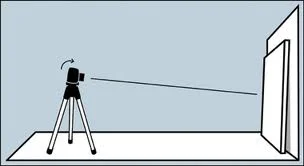
This shooting style - tilting the camera to turn a vertical or horizontal line into a powerful diagonal - has been around for awhile. One term used for it is the "Dutch angle", which is a longtime cinematography; to create visual tension. Still, when I tell clients that it's perfectly acceptable, if not totally desirable, to occasionally slant the camera, they express surprise. After all, your're supposed to keep the camera level at all times, correct? Well, there are exceptions! Used at the right artistic time, a nice tip of the camera can pump up the visual tension by creating exceptional angles and diagonals. Rendering with your camera askew (so as to change naturally appearing vertical or horizontal lines into diagonals) can be done for a variety of small scenes or ambitious views. Like other creative techniques, you won't want to use this method all the time, but when the subject calls for it, angling the camera is one worthy artist weapon.
Did you enjoy this blog post? If so, then why not:
Leave Comment | Subscribe To This Blog | Email Me